
Massac County Court Records After a Jail Arrest
A Massac County arrest starts a path that ends in the circuit court. After officers lodge a person at the county jail and the booking is done, the Massac County State's Attorney reviews the case and decides what to charge. Those filed charges open a court case, and the case file is the court record the public can search. So the court record reflects what the prosecutor charged, which can be more, fewer, or different from the charges listed at the jail.
The booking side and the court side answer different questions. To check whether someone is in custody and what they were booked on, the jail inmate records page covers the roster and jail line, and the jail roster mugshots page covers booking photos. The court record, by contrast, tracks the formal charges through the case, including hearings, motions, and the final outcome. This page stays on the court side of the arrest.
From a Massac County Arrest to a Court Record
The court record does not appear at the moment of arrest. It builds in stages, and each stage adds something to the file. Knowing the order helps a reader understand why a case may show up on the jail side days before it shows clear charges on the court side. The path runs in a straight line through the local system.
Arrest leads to booking at the county jail, then to a first appearance where a judge addresses release or detention, then to the prosecutor filing the charges, which opens the court case. The Office of Statewide Pretrial Services may weigh in on release conditions at the early stage. Only after the charges are filed does a full court record exist to search, which is why the jail roster and the court file can tell slightly different stories early on.
The takeaway is simple. Check custody on the jail side right after an arrest, then follow the court record once the prosecutor has filed. The two sides line up over time, but they update on their own schedules.
How to Find Massac County Court Records After an Arrest
Massac County criminal cases are searched online through Judici, the public case-search gateway for the county. The welcome page is open to anyone, but the case search may ask you to pass a humanity check before it loads. The steps below walk through the search, and the access table records what was and was not visible during research.
- Open the Judici Massac County page and choose the case search.
- Pass the humanity check if one appears, then search by the defendant's name or case number.
- Open the case to read the charge list, hearing dates, and case minutes.
- Check each charge's level and current status, since charges change as a case moves.
The Judici Massac County gateway is shown below, with the link to the county's case search.
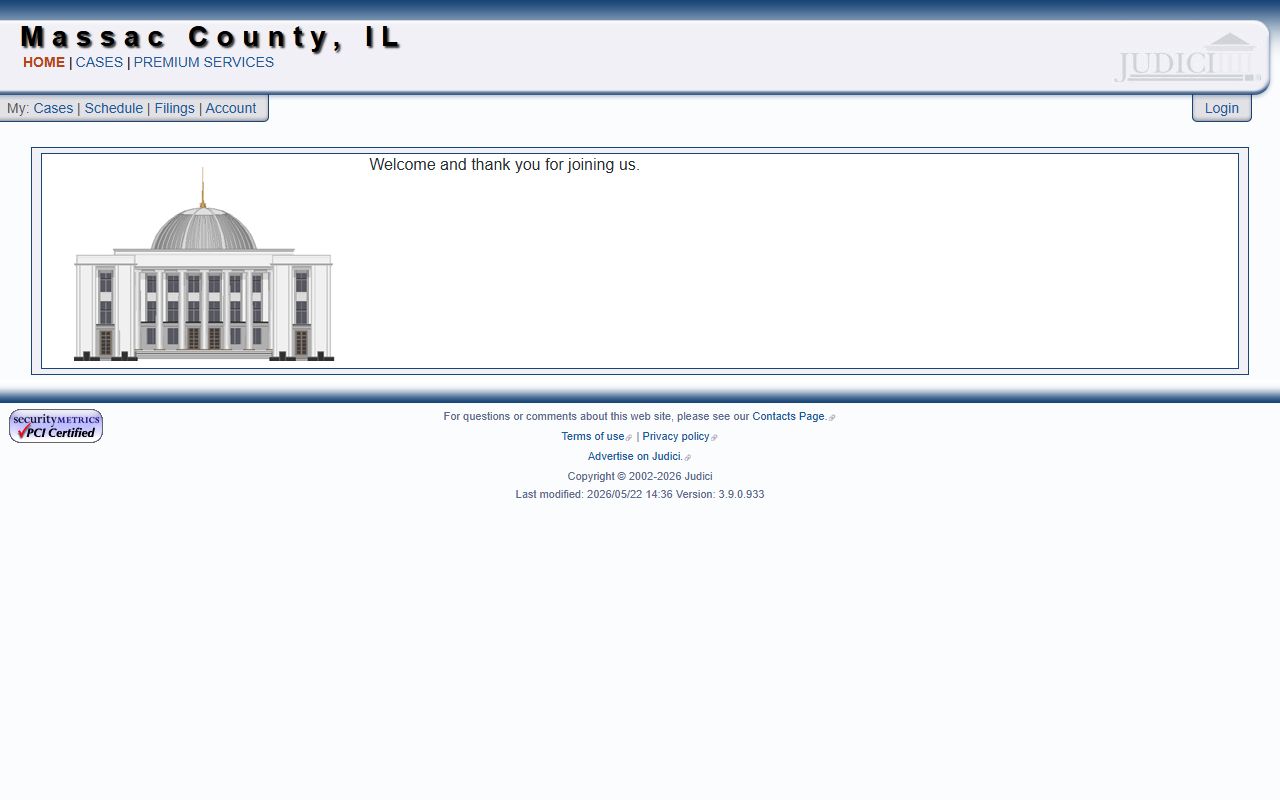
From the page above, the Massac County case search lists litigant information, criminal charges, dispositions, sentences, hearing dates, and documents. For a certified copy or an older file, contact the Massac County Circuit Clerk instead of relying on a screenshot.
| Access Point | How to Reach It | What It Gives |
|---|---|---|
| Judici case search | Browser, free | Charges, dispositions, hearings, documents. |
| Circuit Clerk | Phone, mail, or in person | Certified copies and older or limited files. |
| re:SearchIL | Browser, account may be needed | Statewide court document repository. |
How Charges Get Filed After an Arrest
The court record begins the moment a charging document is filed. After the jail booking, the prosecutor files one of three documents, and the type depends on the offense and the stage of the case. The table sorts the three so the entries in a court file make sense.
| Complaint | Information | Indictment | |
|---|---|---|---|
| Filed By | Officer or prosecutor | Prosecutor | Grand jury |
| Common For | Misdemeanors | Many felonies | Serious felonies |
| Starts | The case | The case | The case |
A booking charge from the arrest is the arresting officer's description at intake. The charge in the court record is what the prosecutor actually files, and it can be amended later. That is why the charge you see on the jail side may not match the charge in the court case word for word.
Charge Status in Massac County Court Records
Charges in a court record do not stand still. As a case moves, a charge can be amended, reduced, added, or dropped, and the prosecutor can decline to go forward. The status terms below show up in case minutes and on the docket, so reading them correctly tells you where a case really stands.
| Status | What It Means |
|---|---|
| Pending | The charge or case is still open and moving. |
| Amended or Reduced | The charge language, count, or level was changed. |
| Dismissed | The charge was ended without a conviction. |
| Nolle Prosequi | The prosecutor chose not to pursue the charge. |
Note: a dismissed or nolled charge still leaves a court record of the case, even though it ended without a conviction.
Who Files Charges in Massac County Court Records
In Illinois the prosecutor is called the State's Attorney, not the district attorney. The Massac County State's Attorney prosecutes crimes committed in the county on behalf of the People of the State of Illinois, handles traffic and county ordinance cases, and represents the county in civil matters. The office also runs a crime victim advocate who helps victims follow a case. Joshua Stratemeyer holds the office, with Mark Hunter as assistant.
The State's Attorney page lists the office's duties and contact details.

The State's Attorney page shown above is the office that decides the charges in the court record. The prosecutor cannot give legal advice to a defendant, so people facing charges should talk to their own attorney or the public defender.
Bond and Release After a Massac County Arrest
Illinois changed how release works after an arrest. Under the Pretrial Fairness Act, money bail was ended for new cases statewide in September 2023. A judge now sets release conditions or orders a person held, instead of setting a cash bail amount. The sheriff's jail page still uses the word bond for payment, and local pages may carry older language, so the table below maps the terms to current Illinois practice.
| Term | How It Works in Illinois |
|---|---|
| Pretrial release | The court releases the person with conditions like appearance or no contact. |
| Detention order | The court orders the person held before trial after the required hearing. |
| Cash bond (legacy) | An older term that may still appear in records or local payment language. |
| Hold or detainer | Another agency's hold can keep a person in custody even after release is cleared. |
Illinois does not use commercial bail bondsmen the way many states do, so hiring a bondsman is not the normal path here. The court controls the release or detention order, and the jail cannot change it. The Office of Statewide Pretrial Services has a Massac County contact who may be involved in release recommendations.
Warrants That Lead to a Massac County Arrest
An outstanding warrant is a common reason a person is booked. The Massac County Sheriff publishes a Most Wanted page and asks the public to report a wanted person to the office or the tip line, but there is no public, searchable warrant database. A missing name on the Most Wanted page is not proof that no warrant exists, so the better check is the court case itself.
Search Judici for the case to see if a failure to appear, a bench warrant, a recall, or a new court date is listed. For an official answer on a warrant, call the sheriff at 618-524-2912 or contact the circuit clerk. A person who thinks they have a warrant should speak with an attorney or the court before acting, and the First Circuit directory below lists the local court contacts.
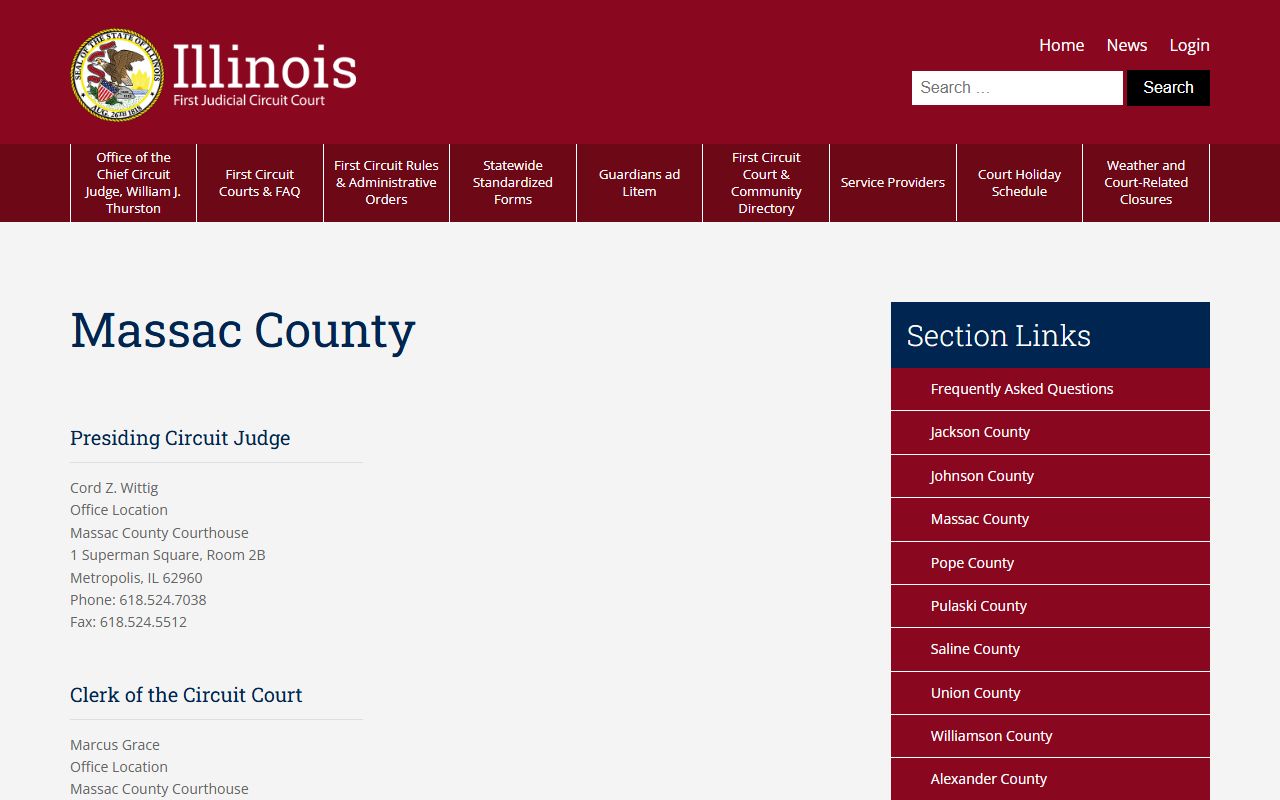
The First Judicial Circuit Massac County directory above lists the circuit judge, the circuit clerk, the State's Attorney, the public defenders, and probation, which is the fastest way to reach the right court office.
Charges vs. Convictions in Court Records
Being arrested and charged is not the same as being convicted. A charge is an accusation that opens the case. A conviction is the outcome after a plea or a verdict. Both appear in the public court record, but they carry very different weight, and the table makes the line clear.
| Charge | Conviction | |
|---|---|---|
| Stage | Accusation | Verdict or plea |
| Burden of Proof | Probable cause | Beyond a reasonable doubt |
| Public Record | Yes | Yes |
Sealed vs. Expunged Arrest Records
After a case ends, some people can clear the arrest and court record. Illinois law treats sealing and expungement differently, and eligibility depends on the charge and the outcome. The table shows the basic difference, but a court order is what actually clears a record.
| Sealed | Expunged | |
|---|---|---|
| Visibility | Hidden from most public view | Destroyed or treated as if it never happened |
| Law Enforcement | Limited access remains | Very limited access |
| Eligibility | Depends on the charge and disposition | Often after a dismissal or acquittal |
If a court seals or expunges a record, the person should use the court order and ask the clerk and sheriff what records are affected. A public site cannot promise that copied data elsewhere will disappear, so the court order is the real tool.
Restricted Court Records After an Arrest in Massac County
Not every court record after an arrest is open. The Illinois Freedom of Information Act, 5 ILCS 140, opens public records unless an exemption applies, and several exemptions touch criminal cases. Juvenile records are handled apart from adult records and are not open to general public inspection. Sealed and expunged cases may not show online even when the clerk still holds restricted files. Active investigations and certain private details can be withheld or redacted as well.
So an online search that returns nothing does not always mean nothing exists. It can mean the record is restricted, sealed, or simply not posted. For a certified or complete file, the circuit clerk is the official source, and a written FOIA request can reach records that are public but not online.
Important: This is a private reference site and not a consumer reporting agency under the FCRA; court record information here may not be used for employment, credit, housing, or other FCRA-covered screening.